
Filipinos on education migration pathways to English-Using destination countries
DOI:
https://doi.org/10.22452/jml.vol35no2.7Keywords:
Migration Linguistics , Educational Migration, International Students, Global Student MobilityAbstract
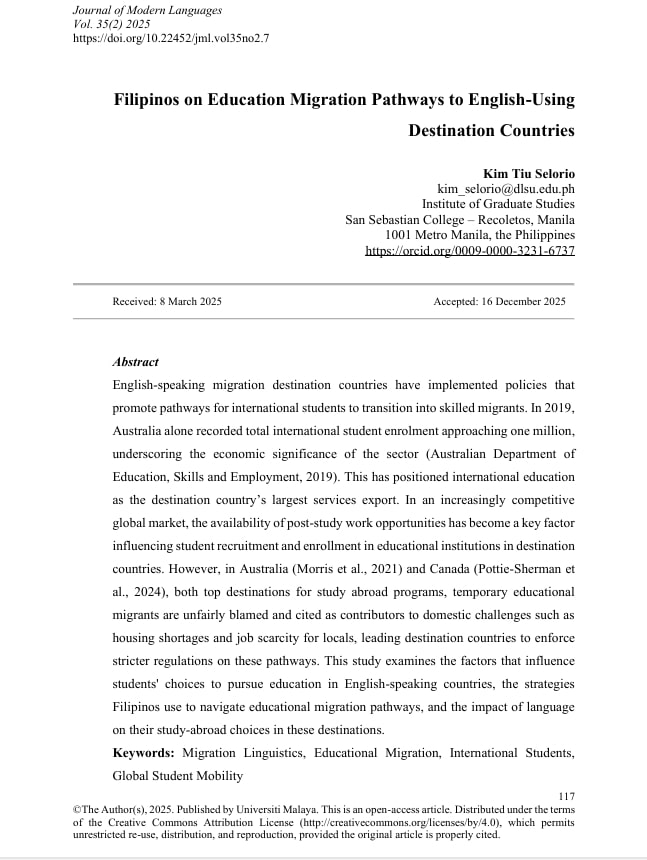
English-speaking migration destination countries have implemented policies that promote pathways for international students to transition into skilled migrants. In 2019, Australia alone recorded total international student enrolment approaching one million, underscoring the economic significance of the sector (Australian Department of Education, Skills and Employment, 2019). This has positioned international education as the destination country’s largest services export. In an increasingly competitive global market, the availability of post-study work opportunities has become a key factor influencing student recruitment and enrollment in educational institutions in destination countries. However, in Australia (Morris et al., 2021) and Canada (Pottie-Sherman et al., 2024), both top destinations for study abroad programs, temporary educational migrants are unfairly blamed and cited as contributors to domestic challenges such as housing shortages and job scarcity for locals, leading destination countries to enforce stricter regulations on these pathways. This study examines the factors that influence students' choices to pursue education in English-speaking countries, the strategies Filipinos use to navigate educational migration pathways, and the impact of language on their study-abroad choices in these destinations.
Downloads
Published
Issue
Section
Categories
License
Copyright (c) 2025 Kim Selorio

This work is licensed under a Creative Commons Attribution-NonCommercial 4.0 International License.